Corvette ZR1 C8 Engineering: How Chevy Built a 233-MPH, 1,064-HP Supercar
How the C8 Corvette ZR1 hits 233 mph: the 1,064-hp twin-turbo LT7 V8, cooling, 1,200 lb of downforce, carbon brakes, DCT and a 6:50 Nürburgring lap.

In this story9 sections
A 1,064-horsepower V8, 233 mph, and a sub-seven-minute Nürburgring lap from a car you can order at a Chevy dealer. Here's how GM's engineers actually pulled it off.
For most of its life, the Corvette was the car that got close to European supercars for a lot less money. The C8 ZR1 doesn't get close. It beats a lot of them outright. Car and Driver measured 0 to 60 mph in 2.2 seconds. GM's president drove one to 233 mph. An engineer lapped the Nürburgring Nordschleife in 6:50.763.
Big power alone doesn't get you numbers like that. Cooling, aerodynamics, brakes, the gearbox and the tires all have to keep up with the engine. Here's what each piece does.
The LT7: a race-bred V8 with two turbos bolted on
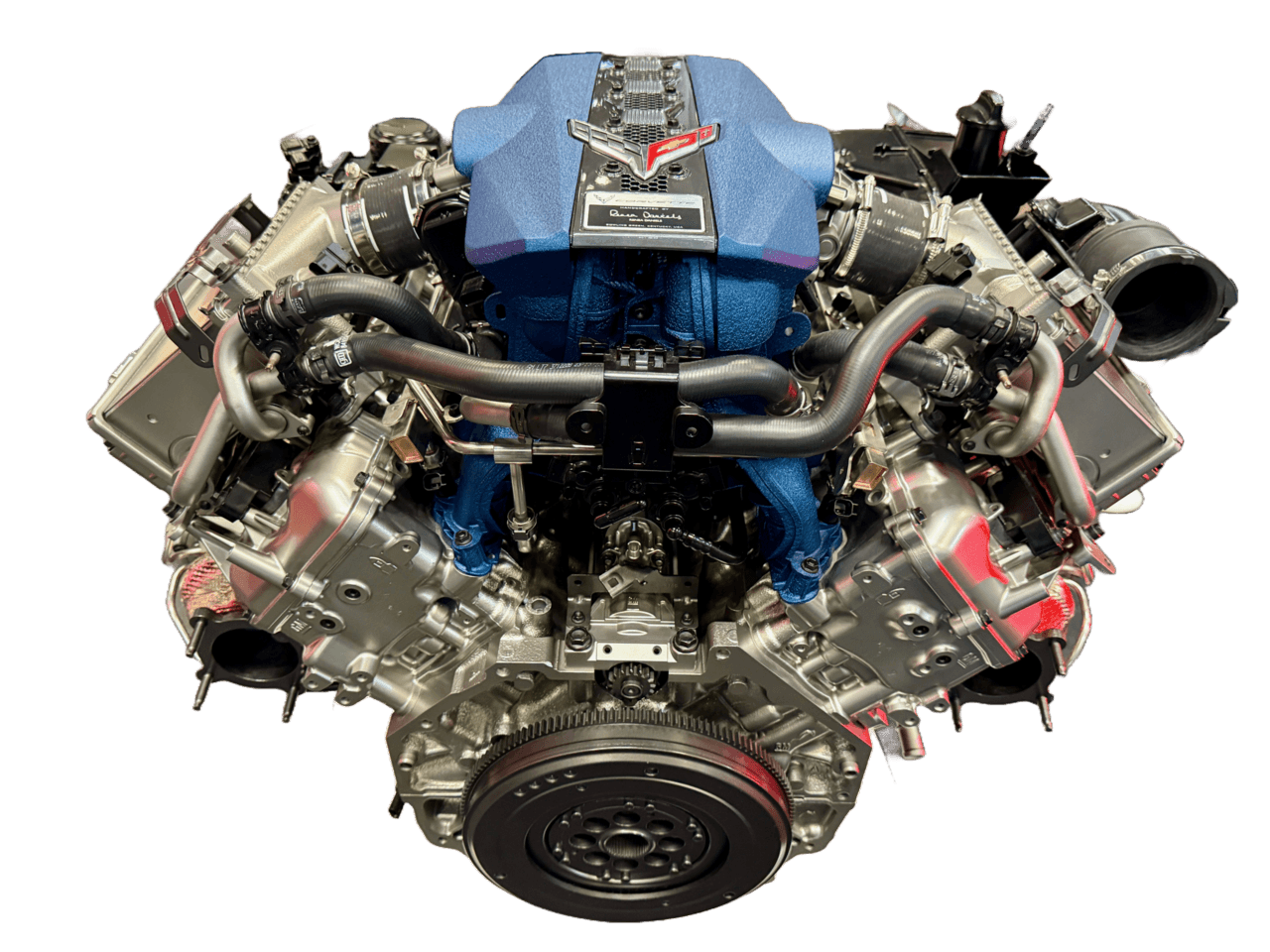
The heart of the ZR1 is the LT7, a 5.5-liter twin-turbocharged V8 with dual overhead cams and a flat-plane crankshaft. Chevrolet rates it at 1,064 hp at 7,000 rpm and 828 lb-ft of torque at 6,000 rpm (per SAE guidelines). GM calls it the most powerful V8 ever produced in America by an automaker. GM also points out that it makes more power than two of the 7.0-liter LS7 engines from the C6 Z06 put together.
The LT7 starts from the same "Gemini" architecture as the Z06's naturally aspirated LT6, which Chevrolet rates at 670 hp. GM is careful to say this isn't just an LT6 with turbos added. Engineers reworked nearly every system for boost:
- New cylinder heads with their own ports and a larger combustion chamber, CNC-machined.
- Exhaust valves built for heat. Turbo engines run hotter exhaust, so the LT7 uses sodium-filled Nimonic exhaust valves, with titanium intake valves.
- New pistons and connecting rods, with crank counterweights changed to match.
- Two fuel systems. Direct injection alone can't supply enough fuel at this output, so GM added a second set of port injectors. The direct injectors run at up to 5,076 psi.
- A seven-stage dry-sump oiling system that keeps oil pressure steady under hard cornering and braking. Many race cars use the same setup.
Turbos tucked in close for instant response
The ZR1 is the first factory Corvette with turbochargers, and GM worked hard to keep it from feeling laggy. It uses two 76 mm mono-scroll turbos with ball bearings and ported shrouds, and they're built into the exhaust manifolds. That cuts the distance exhaust gas has to travel from the valve to the turbine wheel. Less distance means less volume to fill and faster spool.
Electronic wastegates control boost precisely. GM also wrote an "intelligent anti-lag" calibration that adapts to how you're driving and keeps the turbos ready between corners. The payoff, according to Car and Driver, is more than 800 lb-ft from 3,000 to 6,500 rpm. In other words, the car pulls hard almost anywhere in the rev range.
Cooling: the hidden half of making 1,000 horsepower
Compressing air heats it up, and hot air holds less oxygen. So every turbo engine is fighting heat. The ZR1 has two engine-mounted water-to-air charge coolers, and the bodywork is designed around feeding them:
- Flow-through hood: air enters the grille, passes through the intercooler heat exchanger, and exits through the hood. This cools the charge air and adds front downforce at the same time.
- Roof-mounted intakes: carbon-fiber scoops on top of the coupe's rear hatch feed cool air to the turbo compressors.
- Rear brake ducts: carbon ducts behind the doors route air to the rear brakes.
- The split rear window: the carbon "spine" revives a C2 Corvette styling cue, and it also helps pull heat out of the engine bay.
Aero: downforce when you want it, low drag when you don't
GM says the ZR1 makes over 1,200 pounds of downforce at top speed, the most of any Corvette. There are two setups:
- Standard ZR1: sleeker, lower-drag bodywork with a small spoiler (short and tall wicker options), a carbon front splitter, and a front underwing.
- ZTK Performance Package: a high-downforce carbon rear wing, front dive planes, a tall hood Gurney lip, underbody strakes, stiffer springs and Michelin Pilot Sport Cup 2 R tires.
The trade-off is the classic one. Downforce pushes the tires into the road for cornering grip, but it also adds drag. Chevrolet quotes a 225 mph top speed for the ZTK-equipped car. For the 233 mph run, the cars wore the smaller spoiler and short wicker.
Brakes, wheels and the gearbox
Stopping a 233 mph car is a huge heat problem. The ZR1 uses carbon-ceramic rotors, 400 mm (15.7 in) up front and 390 mm (15.4 in) at the rear. GM says the front rotors are the largest ever fitted to a Corvette. GM's launch spec sheet lists six-piston front and four-piston rear monobloc calipers. Its Nürburgring release lists 10-piston fronts and 6-piston rears for the ZTK car. Chevrolet says the ZR1 can go 80 to 200 mph and back down to 80 in 24.5 seconds, 22% quicker than the C7 ZR1.
The optional carbon-fiber wheels cut unsprung mass by 42.8 lb, according to GM. Unsprung mass is everything the springs don't carry, like wheels, tires and brakes. Less of it means the tires follow bumps better and stay in contact with the road.
All that torque goes through the M1K eight-speed dual-clutch transmission, which GM strengthened for the ZR1 with upgraded input shafts, shot-peened gears, more clutch clamping force and better oil control under high g-loads. A dual-clutch box preselects the next gear, so shifts take milliseconds and power barely drops during a shift.
The numbers
- 0–60 mph: 2.2 seconds (Car and Driver test, ZTK car, 1-ft rollout omitted). Chevrolet claims 2.5 seconds for a ZR1 without the ZTK package.
- Quarter mile: 9.5 seconds at 149 mph (Car and Driver). GM's own estimate was "sub-10 seconds."
- 0–200 mph: 23.8 seconds (Car and Driver).
- Top speed: 233 mph, a two-way average driven by GM President Mark Reuss on the high-speed oval at ATP Automotive Testing Papenburg in Germany. The car hit redline in sixth gear.
- Nürburgring Nordschleife: 6:50.763, driven by GM vehicle dynamics engineer Brian Wallace in a ZTK-equipped car. It's listed in the Nürburgring's official Prototype/Pre-Production category because the ZR1 isn't sold in Europe.
How it stacks up against rivals
In Car and Driver's testing, the ZR1 is the quickest rear-wheel-drive car the magazine has ever tested to 60 mph. It beat the McLaren 750S by a tenth and the Ferrari 296 GTB by two. In the quarter mile it ran 9.5 seconds against 9.8 for the McLaren and 9.7 for the Ferrari.
On the Nordschleife, the ZR1's 6:50.763 was just over a second behind the Porsche 911 GT3 RS (6:49.328) and ahead of the Ford Mustang GTD (6:52.072). The hybrid all-wheel-drive Corvette ZR1X went even quicker at 6:49.275. For context, the Z06 lapped in 7:11.826 on the same trip.
Top speed is where the value case gets wild. GM says 233 mph is a record no current production car under $1 million can match. Bugatti's Chiron Super Sport 300+ is much faster, but The Verge noted the ZR1 started at $174,995 while the Bugatti costs somewhere north of $4 million.
Why it matters
The C8 ZR1 shows what a whole-car approach gets you. The turbos sit close to make the engine responsive. The bodywork is shaped to keep it cool. The aero puts that power to the ground, and the carbon brakes and wheels help it change direction and stop. Nothing on the list is a gimmick, and almost every piece serves more than one job.
See where the ZR1 ranks on our fastest cars list, its full entry, the Nürburgring lap times leaderboard, and our explainer on how 'Ring times are measured.
Sources
- Nürburgring: Corvette Z06, ZR1 and ZR1X official lap timesnuerburgring.de
- Car and Driver: 2025 Chevrolet Corvette ZR1 Testedcaranddriver.com
- Road & Track: Corvette ZR1X, ZR1 and Z06 Nürburgring lap timesroadandtrack.com


